
How Much Does Direct Market Access to CME Cost?


Deciding whether to go live on CME with low-latency DMA infrastructure often comes down to knowing the costs and resources it takes to get started. There are several layers to think through: the platform, the exchange, the clearing firm, and the costs that depend on how you trade. This post lays them out in one place: what our offer covers, what changes the total, and which numbers are not ours to set.
Nanoconda cost summary. The Simulator costs $250 for three months, and managed live plans cost $2,100–$4,800 a month at monthly rates.
What makes up the bill
The first useful distinction is between what you pay to keep the setup running and what you pay each time you trade. Then there are the costs of getting started and, eventually, leaving.
| Type of cost | What belongs here | How to budget it |
|---|---|---|
| Recurring | DMA platform access, market-data licenses, any monthly minimum charges from your FCM, additional resources or sessions | Monthly amounts for your particular configuration |
| Activity-dependent | Exchange and clearing fees, regulatory assessments, applicable session or messaging charges | Trading volume, session type and messaging behavior |
| One-time | Platform setup, applicable session activation and decommissioning | Separate from the recurring monthly total |
DMA platform access. This is the software and infrastructure used to connect your strategy to the exchange. It may be a Nanoconda subscription or another DMA solution. Depending on the setup and plan, the price can include the order gateway, market-data feed handler, risk controls, allocated computing resources, exchange connectivity, monitoring and system administration.
The data license. Your strategy needs live prices and order-book updates when it trades. The right to use that CME data is licensed separately from the DMA platform. This is different from the recorded historical data used for backtesting, which you can get from a provider such as Databento.
CME licenses market-data use through its Information License Agreement (ILA). The agreement and its schedules identify which exchanges' data you may use and what you may do with it, such as automated trading or displaying prices in a GUI. Your fees depend on those permissions and the applicable charging units; the ILA is the contractual framework, not another flat fee to add to your budget.
CME distinguishes between display and non-display use. Display use means a person views market data on a screen, such as a chart, DOM, or trading GUI. Non-display use means software uses the data for tasks such as analyzing prices, generating signals or submitting orders automatically. If an automated trading application also displays real-time data to traders, both uses are licensed and carry separate fees. Showing live prices in a GUI does not remove the separate licensing requirement for the algorithm that uses those prices to trade. CME's non-display guidance, question 6 explains this combination and its reporting requirements.
The charging unit is generally a Designated Contract Market (DCM), rather than a futures product. CME Group operates four DCMs: CME, CBOT, NYMEX and COMEX. E.g., ES and NQ use market data from the same DCM, CME, so one license covers both. ES and crude oil use data from two DCMs, CME and NYMEX, so two sets of market-data fees apply.
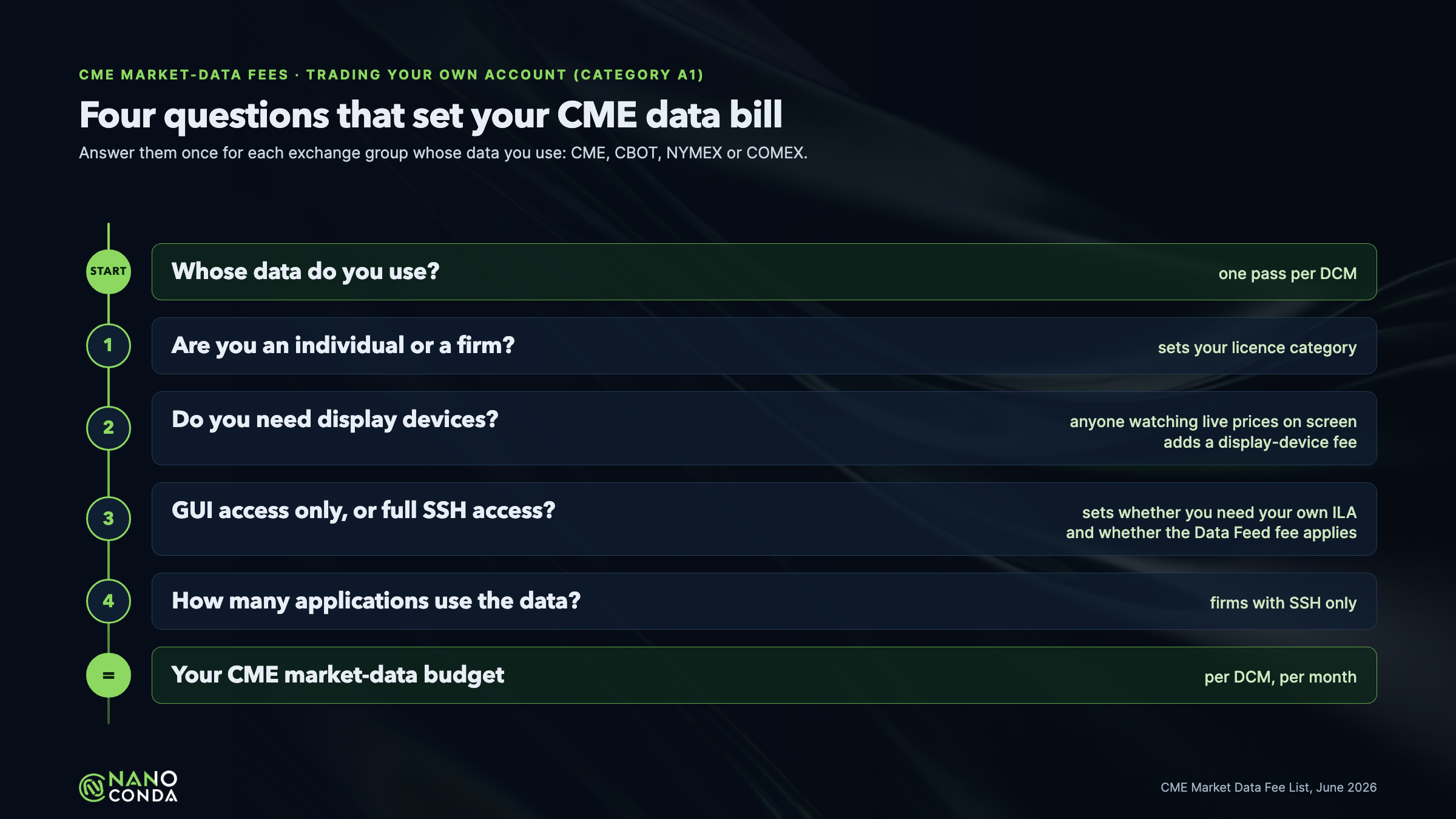
Many of our clients trade their own account, which CME licenses as Category A1, trading as principal. CME has other categories, such as A2 for trading on behalf of clients, A3 for using CME data to trade on another venue, and Categories B and C for internal matching, risk and research. They carry their own rates and can apply alongside A1, but they are less common among DMA live clients and are not covered here. Within A1, four setups cover nearly every case. Two things decide which one is yours: whether CME licenses you as an individual or a firm, and whether you use the platform through the GUI only or with full SSH and API access. For each setup, three questions matter: whether you need your own Information License Agreement with CME, whether the Data Feed fee applies, and what the monthly total is.
| Setup | ILA with CME | Non-display fee per DCM, per month | Data Feed fee |
|---|---|---|---|
| Individual, GUI access only (no SSH or API) | Not needed | Managed User Non-Display Category A: $208 | Not applicable |
| Individual, full SSH access | Required | User Non-Display Category A: $457 | Not applicable |
| Firm, GUI access only | Required, for Category A1 as a semi-automated system | A1: $609 for one application | Not applicable |
| Firm, full SSH access | Required, for Category A1 | A1: $609 / $1,820 / $3,640 for one / two to three / four or more applications | Applies: $610 per DCM |
Fees are from the June 1, 2026 Market Data Fee List.
The two individual rates are licensed to one natural person. The firm tiers scale with application count. For those tiers, CME defines an application as a system or piece of software that uses market data for non-display purposes. The count is based on the inventory agreed with CME within each DCM, rather than the number of products or strategies you trade. A firm whose traders also watch live prices on screen pays CME's display-device fee for each device.
The Data Feed fee is CME's separate charge for the real-time feed itself, counted per feed and per DCM. It applies to firms with API access (such as full SSH) that receive data from a vendor. The quick rule for this fee is: "Am I capable of extracting data into an internal system programmatically?" It does not replace the non-display license, and it is separate from hardware, connectivity and feed-handler software.
Trading and clearing. To trade live, you need a clearing relationship with a futures commission merchant, or FCM. The FCM sponsors your access to CME Globex and enables the relevant markets and products for your account. Your DMA platform provides the technical route for submitting orders through an iLink session, but connection to CME Globex does not automatically give you permission to trade every CME Group exchange or product. These trading permissions are separate from the market-data licenses described above.
As an infrastructure provider, we can work with any US-registered FCM that offers CME-sponsored access. When choosing one, ask for a commission quote and compare the full cost: account minimums, recurring charges and the per-contract rate. For example, a non-member trading E-mini S&P 500 futures as Globex outrights pays $1.38 per contract, per side in exchange fees under the September 14, 2026 CME schedule. Opening and closing one contract therefore costs $2.76 in exchange fees before FCM commission and applicable regulatory charges. Membership or incentive-program eligibility can change the exchange rate.
Session charges. The inactivity fee depends on the connection. CME's published iLink session policy, section 2.3, lists $1,000 a month for an MSGW session below 1,000 traded sides, and $100 for a CGW session below 100 sides. These are per-session thresholds, not a blanket charge on every low-frequency trader.
A strategy that sends many orders and cancellations also needs to account for CME's Messaging Efficiency Program, version 11.9 and its 2026 product-group benchmarks. Charges can apply when activity exceeds the program's thresholds. Flat platform pricing does not remove exchange messaging rules.
Which plan do you need?
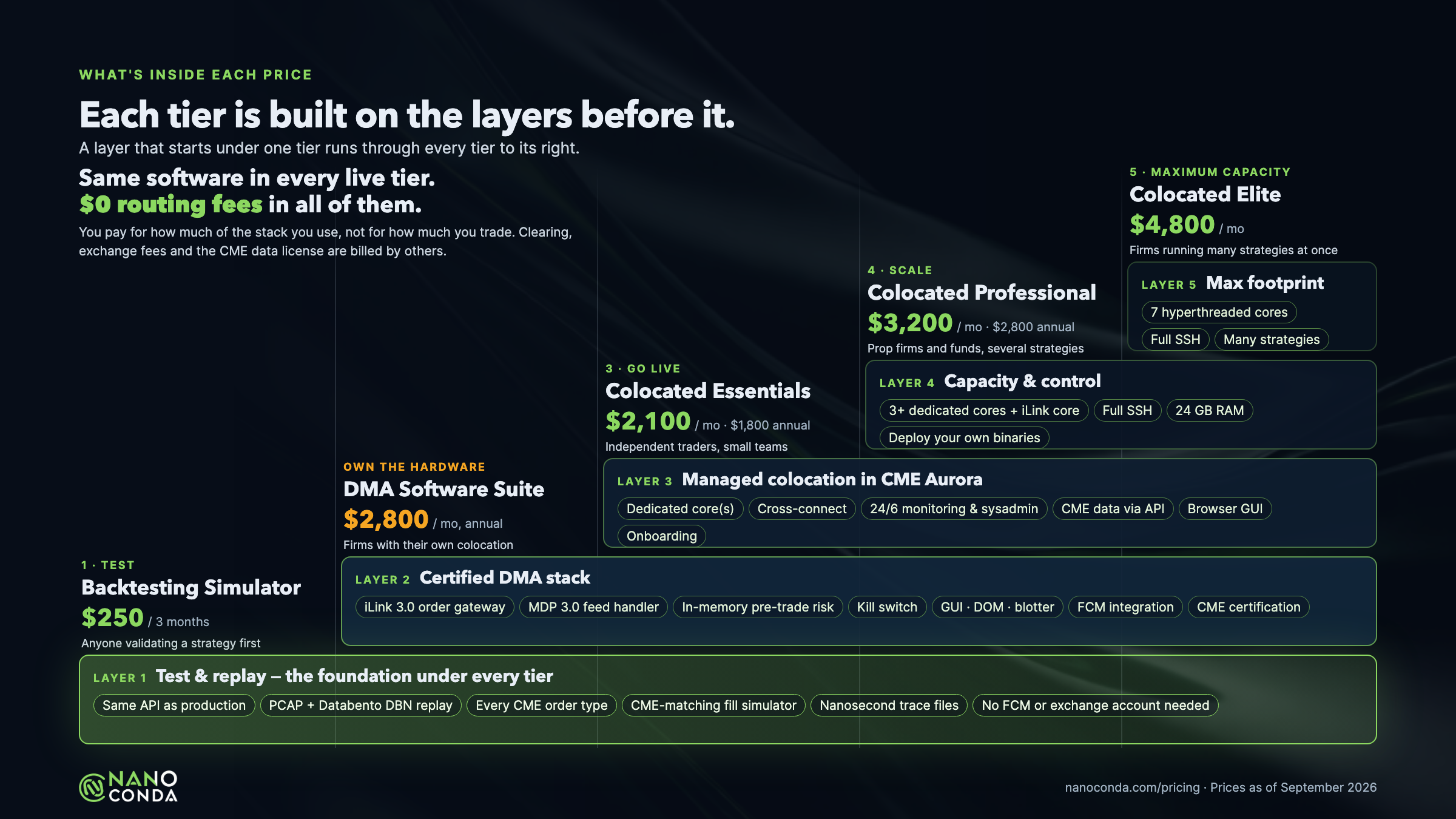
Nanoconda products cover the path from testing a strategy to running it in production. The live tiers share the core trading software. What changes are the capacity you get, the access you have, and who takes responsibility for running the infrastructure.
| Plan | Price | Resources and access | Who runs the infrastructure? |
|---|---|---|---|
| Backtesting Simulator | $250 for three months | Replay on your own machine; same API as production | You |
| Colocated Essentials | $2,100/month; $1,800/month on annual billing | One dedicated core; browser GUI; no SSH | Nanoconda, with 24/6 managed operations |
| Colocated Professional | $3,200/month; $2,800/month on annual billing | Three dedicated cores; full SSH | Nanoconda, with 24/6 managed operations |
| Colocated Elite | $4,800/month; annual discount available | Seven dedicated hyperthreaded cores; full SSH | Nanoconda, with 24/6 managed operations |
| DMA Software Suite | $2,800/month on an annual commitment | Your own hardware and system access | You |
Prices are valid as of the publication date. Contact our team for current pricing and a quote for your configuration.
The three colocated plans differ only in capacity and access. Essentials is one core with GUI control and no shell, which allows for reduced market data fees. Professional adds SSH and three cores for teams that deploy their own code. Elite is the largest listed footprint, for firms running many strategies at once. Every live plan covers the CME exchange group by default; each additional exchange group (CBOT, NYMEX, COMEX) is $400 a month.
Setup and exit. Budget $500 for Nanoconda's managed setup and a $500 cleanup fee when the container is decommissioned. Ask for the quote to identify any separate exchange activation and testing charges. Keeping these lines separate makes the first and final bills easier to understand.
With any managed live plan, CME connectivity is part of the service. The Software Suite gives you the feed-handler software, while your team provides the hardware, data connection and day-to-day operations. It suits teams that want full control of the machine and have the resources to run it. The shared stack includes the MDP 3.0 feed handler, iLink 3.0 order gateway, pre-trade risk, GUI, simulator, replay and trace tools, with FCM integration support. Protocol updates and maintaining the software's CME certification are part of our work. Market-data usage rights remain a separate cost, discussed above.
Why does this cost less than building it yourself? We build and maintain the core software once and use it across clients. As a CME-certified independent software vendor (ISV), we spread development and certification costs across subscriptions. Your subscription covers your allocated resources and operations without requiring you to fund a gateway, feed handler and risk system from scratch.
Who bills what. Nanoconda invoices the subscription, the $400 per additional exchange group, and the one-time setup and cleanup fees. CME's market-data fees are set by the exchange: where you hold your own ILA, CME bills them to you under that agreement. Clearing commissions and exchange transaction fees come through your FCM.
Budget from testing to production
- Research and simulation. The $250 Simulator license covers three months and includes sample data. Additional history depends on your symbols, dates and schema; Databento's cost-estimation endpoint helps price it. Include realistic fees and latency in your tests; simulation results do not establish live profitability.
- Clearing, licensing and staging. Arrange your FCM account and CME licensing in parallel. Agree when billing starts and budget for live-data testing before your first live trade, including the plan and sessions needed to test risk limits and recovery.
- Account funding. Keep futures margin and capital for trading losses separate from infrastructure spending. Allow enough operating cash to evaluate the strategy without relying on immediate profits.
When is it worth paying for DMA?
DMA is worth paying for when improved execution and savings from a high volume of trading cover the added operating costs, after trading fees and realistic execution losses. If faster execution adds little to your strategy and trading volume is low or inconsistent, a less expensive setup may be sufficient.
A retail platform normally includes a GUI and an API that reaches the exchange through several intermediate hops, with latency in the hundreds of microseconds or worse. What you are getting with Nanoconda is a dedicated core on a server inside CME's own data center, a direct exchange session, a certified order gateway, and a team that keeps it running around the clock. Order-to-wire on the shared-memory path is about one microsecond. That is not a faster version of the retail product; it is a different product, and the price reflects the hardware, colocation, and operations behind it.
For an in-house build, Nanoconda estimates $200,000–$1,000,000 and twelve to eighteen months for one to three senior engineers to build the gateway, feed handler and risk layer, complete CME certification, and arrange hardware and connectivity.